Shared Time article in the Detroit News, page 1, Saturday, March 9, 1963. Continued on page 2A (below)
Here is the text of the article seen above.
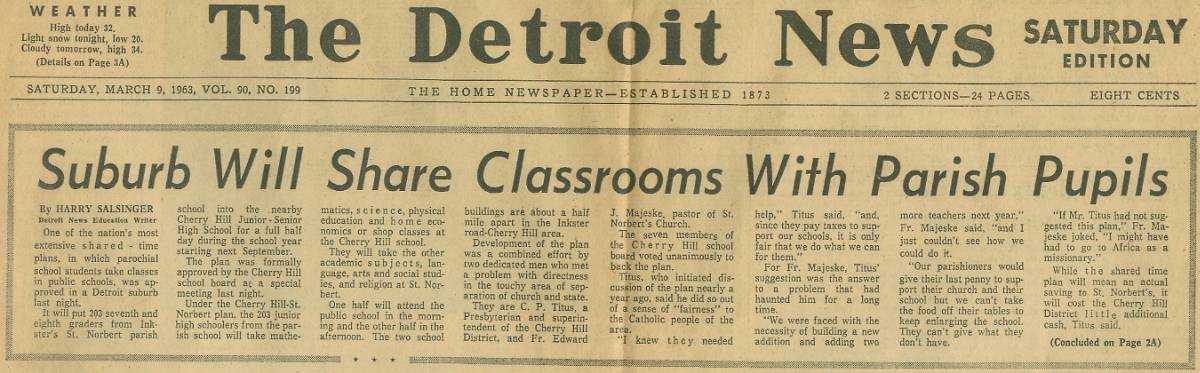
The Detroit News, Saturday Edition, SATURDAY, MARCH 9, 1963
Suburb Will Share Classrooms With Parish Pupils
By HARRY SALSINGER
One of the nations most extensive shared - time plans in which parochial school students take classes in public schools, was approved in a Detroit suburb last night.
It will 203 seventh and eighth graders from Inkster's St. Norbert parish into nearby Cherry Hill Junior - Senior High School for a full half day during the school year starting next September [1964].
The plan was formally approved by the Cherry Hill school board at a special meeting last night.
Under the Cherry Hill - St. Norbert plan, the 203 junior high schoolers from the parish will take mathematics, science, physical education, and home economic or shop classes at the Cherry Hill School.
They will take the other academic subjects, language, arts and social studies, and religion at St. Norbert.
One half will attend the public school in the morning and the other half in the afternoon. The two school buildings are about a half mile apart in the Inkster road-Cherry Hill area.
Development of the plan was a combined effort by two dedicated men who met a problem with directness in the touchy area of separation of church and state.
They are C. P. Titus, a Presbyterian and superintendent of the Cherry Hill District, and Father Edward J. Majeske, pastor of St. Norbert's Church.
The seven members of the Cherry Hill school board voted unanimously to back the plan.
Titus, who initiated discussion of the plan nearly a year ago, said he did so out of a sense of "fairness" to the Catholic people of the area.
"I knew they needed help," Titus said, "and since they pay taxes to support our schools, it is only fair that we do what we can for them."
For Fr. Majeske, Titus' suggestion was the answer to a problem that had haunted him for a long time.
"We were faced with the necessity of building a new addition and adding two more teachers next year," Fr. Majeske said, "and I just couldn't see how we could do it."
Our parishioners would give their last penny to support their church and their school but we can't take the food off their tables to keep enlarging the school. They can't give what they don't have.
If Mr. Titus had not suggested this plan," Fr. Majeske joked I might have had to go to Africa as a missionary."
While the shared time plan will mean a saving to St. Norbert's, it will cost the Cherry Hill District little additional cash, Titus said.
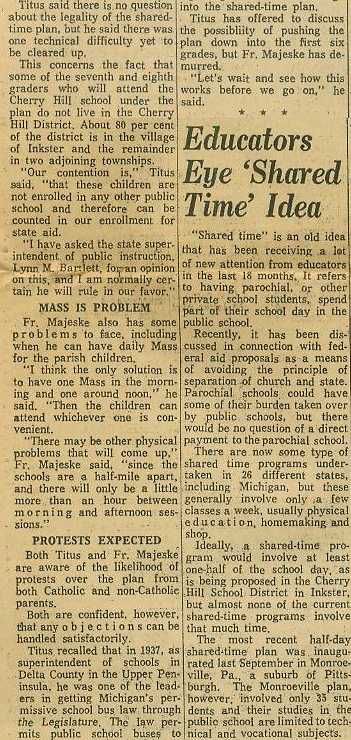
Titus said there is no question about the legality of the shared-time plan, but he said there is one technical difficulty yet to be cleared up.
This concerns the fact that some of the seventh and eighth graders who will attend the Cherry Hill school under the plan do not live in the Cherry Hill District. About 80 per cent of the district is in the village of Inkster and the remainder in two adjoining townships.
"Our contention is," Titus said, "that these children are not enrolled in any other public school and therefore can be counted in our enrollment for state aid.
I have asked the state superintendent of public instruction, Lynn M. Bartlett, for an opinion on this, and am normally certain he will rule in our favor."
MASS IS A PROBLEM
Fr. Majeske also has some problems to face, including when he can have daily Mass for the parish children.
"I think the only solution is to have one Mass in the morning and one around noon," he said. "then the children can attend whichever one is convenient.
There may be other physical problem that will come up," Fr. Majeske said, "since the schools are a half-mile apart, and there will only be a little more than an hour between morning and afternoon sessions."
PROTESTS EXPECTED
Both Titus and Fr. Majeske are aware of the likelihood of protests over the plan from both Catholic and non-Catholic parents.
Both are confident, however, that any objections can be handled satisfactorily.
Titus recalled that in 1927, as superintendent of schools in Delta County in the Upper Peninsula, he was one of the leaders in getting Michigan's permissive school bus law through the legislature. The law permits public school busses to [the rest of the sentence is cut off]
Titus has offered to discuss the possibility of pushing the plan down into the first six grades , but Fr. Majeske has demurred.
"Let's wait and see how this works before we go on," he said.